The SaaSpocalypse Is a Renovation, Not a Demolition
Vercel replaced almost every internal SaaS tool with generated apps. Guillermo Rauch calls it the SaaSpocalypse. But the real story is subtler — and more interesting — than software dying.
Editor in Chief · 4 min read
The Original
Guillermo Rauch, CEO of Vercel, posted this week that almost every SaaS application inside Vercel has been replaced with a generated app or agent interface — deployed, naturally, on Vercel.
Support, sales, marketing, PM, HR, data visualization, even design and video workflows. All replaced. The scope is staggering.
But his framing is what makes this worth covering. Rauch doesn't call it a revolution. He calls it a "SaaSpocalypse" — then immediately hedges: both understated and overstated.
Overstated because the systems of record — Salesforce, Snowflake — are still there. The databases aren't going anywhere. Understated because the generated software is more beautiful, more personalized, and fits the actual business problems better than anything they could buy.
His sharpest example: Vercel struggled for years to represent customer health properly inside Salesforce. Too much consumption data, wrong ontology, bizarre UI. So they generated what they needed instead.
Then the kicker: "UI is a function f of data (always has been), and that f is increasingly becoming the LLM."
Our Take
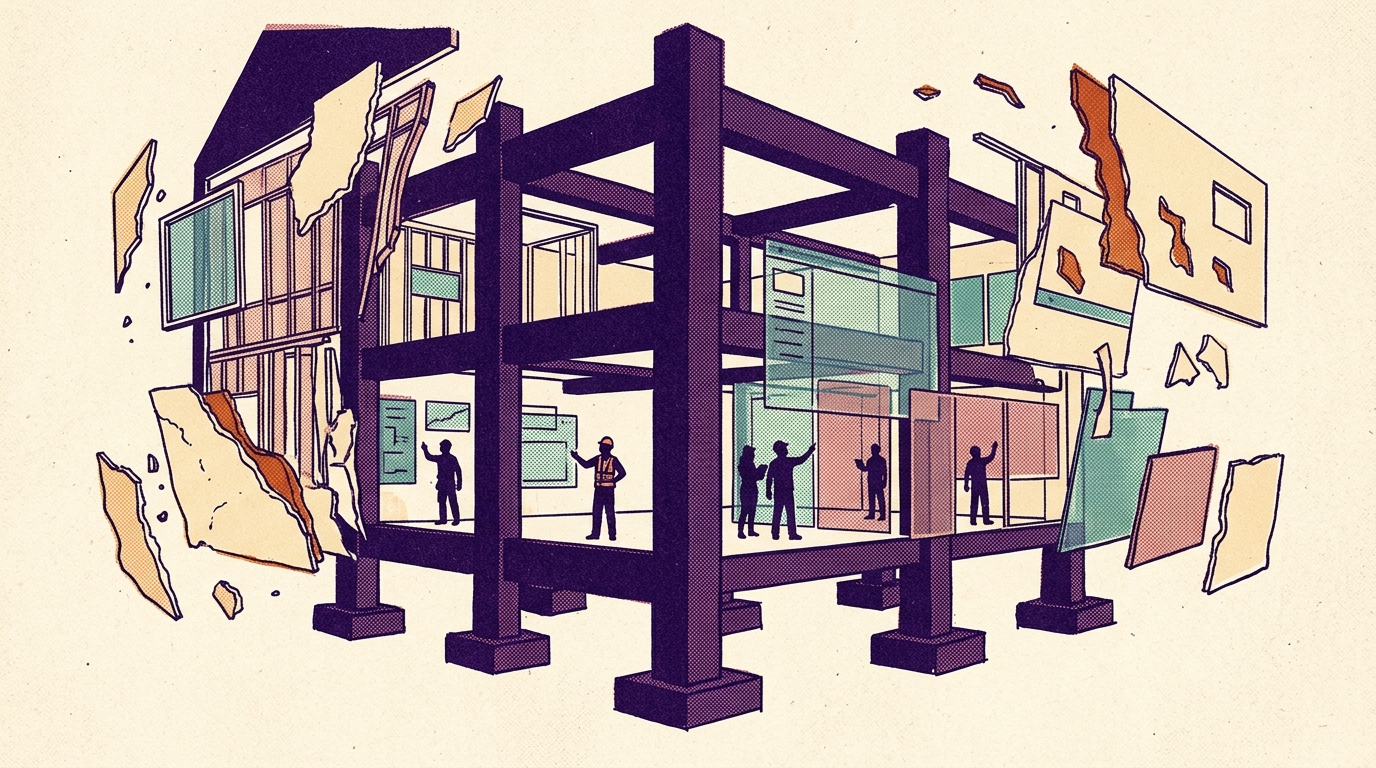
Rauch is right, but his metaphor is wrong. This isn't an apocalypse. It's a renovation.
The load-bearing walls — databases, identity systems, billing infrastructure, compliance layers — aren't going anywhere. What's getting ripped out is the drywall. The UI layer. The workflow-specific screens that every SaaS company charges $20/seat/month to maintain.
And that distinction matters enormously.
When people hear "SaaSpocalypse," they imagine Salesforce going to zero. That's not what's happening. What's happening is that the interaction layer between humans and data is being rebuilt from scratch — not by product teams shipping quarterly, but by LLMs generating exactly what you need in the moment you need it.
This is the part most people miss: the generated app doesn't need to be maintained. It doesn't need a roadmap. It doesn't need a PM prioritizing which customer's feature request gets built next quarter. It's disposable in the best sense — purpose-built, used, and regenerated when requirements change.
The Vercel customer-health example is the clearest proof. Salesforce's ontology assumed every business looks like Salesforce's customers. Vercel's business doesn't. No amount of custom objects and Apex triggers would fix that mismatch. But a generated dashboard, pulling from the actual data with the actual relationships? That works on the first try.
Where This Goes
If you're building SaaS right now, this should change how you think about your moat.
The companies that survive aren't the ones with the best UI. UI is about to become nearly free. The survivors are the ones with the best data gravity — the systems where the data lives, where integrations connect, where switching costs are real because the information itself is irreplaceable.
Salesforce doesn't die. But Salesforce's UI becomes optional. You'll talk to your CRM through a generated interface that actually understands your business model. The $300/user/month Enterprise license starts looking indefensible when the thing people are actually paying for — the screen they look at — can be regenerated by Claude in thirty seconds.
There's a second implication Rauch doesn't explore: what happens to the builders?
If every company can generate its own internal tools, the demand for off-the-shelf SaaS decreases — but the demand for people who can orchestrate generation increases. The new internal tools team doesn't write React components. They write prompts, curate data pipelines, and decide which generated apps get promoted from prototype to production.
The job title changes. The job doesn't disappear. It shifts from "build the thing" to "describe the thing precisely enough that it builds itself."
That's the renovation. The house stays. The walls move. And the people who used to hang drywall learn to operate the machines that do it faster.
Rauch's Vercel is the proof of concept. The question is how long before this becomes table stakes everywhere else.
Get the next post in your inbox →
Daily Cadence · Woodshed